
Description
Adds a unit to the field — temporary or permanent. Covers ability summons (pets and minions like Mama Beak's Tiny Beaks, Zyra's plants, or the Spirit Walker Yorick leaves behind when he dies), trait-spawned minions and relics, resurrect/revive of fallen allies, and bench-to-field arrivals. Summon-buff augments and the Summoner trait scale these. Bench refers to expanding bench slots, not the act of summoning; clone refers to making an exact copy of an existing unit, not summoning a new entity.
Champions (8)
Refine list…
-
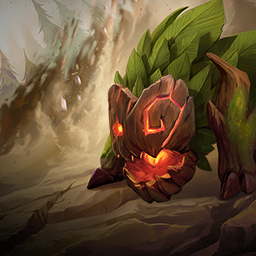
Razor Leaves Summon five razor-sharp leaves that converge on the current target, dealing a total of 370 / 555 / 835 physical damage and applying 20% Wound and 1% Burn for 4 seconds. Scarlet Buff: Cinderling gains 22% Attack Damage each cast. Wound: Reduces healing received. Burn: Deals a percent of the target's max Health as true damage every second. -
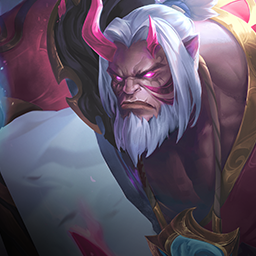
Last Rites Passive: On death, spawn a Spirit Walker with 330 / 634 / 1171 max Health which immediately taunts, forcing enemies to attack it. Active: Restore 280 / 325 / 435 Health and strike the target, dealing 150 / 225 / 340 physical damage.
-
Arise! Gain 150% Attack Speed and summon 2 soldiers for the next 6 attacks. These attacks are replaced by commands which direct each soldier to deal 40 / 60 / 96 magic damage per attack. -
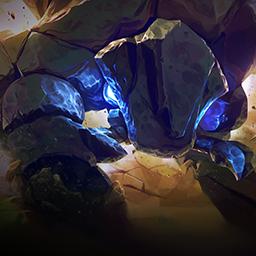
Rock and Roll Passive: On death, split into two Kruglettes with 182 / 338 / 608 Health which immediately taunt, forcing enemies to attack them. Active: Gain 175 / 225 / 325 max Health, then roll into the target, dealing 223 / 358 / 620 damage. Slate Buff: On death, Krug and Kruglettes Shield allies for 8% max Health.
-
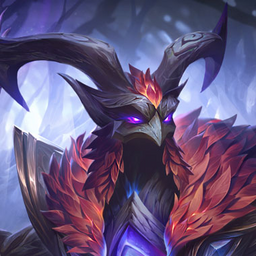
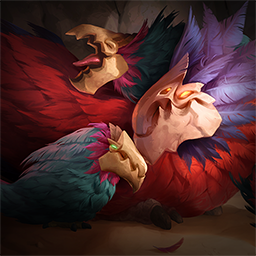
Flock Family Summon 4 untargetable Tiny Beaks nearby for 5 seconds. Whenever Mama Beak attacks, Tiny Beaks attack the same enemy, dealing 20 / 30 / 48 physical damage. Orange Buff: Dealing physical damage reduces enemy Armor by 2.
-
Withering Curse Passive: Gain 25% Omnivamp. Active: Fire a dark blast at 3 nearby enemies, dealing 60 / 90 / 500 magic damage to them and cursing them for 4 seconds. Then, spawn a ? Hex withering zone for the same duration that deals 33 / 50 / 500 magic damage per second. Cursed enemies take 22 / 33 / 240 more damage per curse.
-
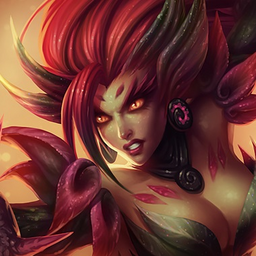
Rampant Growth Spawn 2 / 2 / 4 plants around the battlefield that attack the nearest enemy 10 times. Each attack deals 37 / 55 / 225 magic damage. -
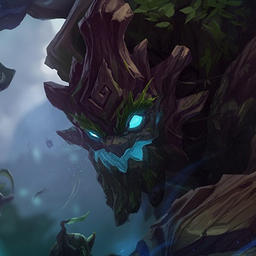
Sow the Seeds Passive: After every 650 / 650 / 300 damage blocked, a sapling jumps towards a nearby enemy and deals 81 / 145 / 2795 magic damage. On death, 3 / 5 / 10 saplings jump out. Active: Deal 69 / 124 / 3726 magic damage to target and restore 330 / 400 / 2000 + 10 / 10 / 100% missing Health.












Traits (4)
-
Gain placeable Elderwood plants.
-
Gain the Big Furry Friend. Drop a Sprykin on the BFF to pick its Rider.
-
Summoners empower their summons in different ways.

Yorick: +30% Health
Azir: +45% Damage
Mama Beak: +45% Damage
Zyra: +4 Plant Attacks
-
Your team gains 5% Durability, increased to 10% if 6 or more Zyra plants are alive.


More Summon sources
What enables Summon (3)
Augments (3)
Prismatic (2)
-
 Nesting Dolls+ Prismatic
 After a champion dies in combat, spawn a copy of them one star level lower with 60% health. Gain 3 free rerolls.
- Nesting Dolls++ Prismatic
After a champion dies in combat, spawn a copy of them one star level lower with 60% health. Gain 3 free rerolls.
Gold (1)
-
 Small Furry Friend Gold
 While Sprykin is active, gain a second BFF summon that is 35% as powerful. Gain a Teemo, a Veigar, and a Kobuko.
Frequently asked questions
-
What does "summon" mean in TFT?
A summon is a secondary unit added to the board mid-combat by an ability, item, augment, or trait — turrets, ghouls, voidlings, mini-pets, trait-spawned minions and relics. Summons fight alongside your champions, can move, attack, and be targeted by enemies, but they aren't shop-bought champions: you don't place them on the bench, you don't equip them with items, and they typically have their own scaled HP / AD / AP pool tied to the summoner. Summon-scaling traits and augments (a trait that spawns paired summoned units and scales their power by the total star level of members with that trait, for example) exist specifically because summons form their own stat-class.
-
What's the difference between a summon and a clone?
A clone is a duplicate of an existing unit — it copies the source's stats, items, and abilities, and counts as a separate body on the board. A summon is a distinct, usually pre-defined entity (turret, ghoul, pet, relic, trait minion) created from scratch by the trigger; it has its own scaled stats and never inherits items. Both are technically "non-shop" units and share the same hard rules — no item slots, share most trait-counting rules — but they originate differently. See clone for the duplicate-of-an-existing-unit case.
-
Do summoned units count toward the summoner's traits?
Generally no. Summons are separate entities, not extra copies of the source champion, so they don't add to your origin/class trait counts the way fielding another shop unit would. The same rule applies to clones. The exception is when a trait specifically lists its summon as one of its members (some bond-of-the-stars-style trait minions can be tagged into the trait that spawned them) — read the trait's tooltip directly, since this is set-specific. Summon-buff traits scale the spawned units rather than counting them.
-
Can I put items on a summoned unit?
No. The 3-item-per-unit rule documented on the Item page applies to champions, and summoned units aren't champions for the purpose of item-equipping — there is no slot UI on them and the engine refuses item drops onto them. The same holds for most clones (a clone-summoning artifact is the relevant exception: it copies the holder's existing items, but you still can't add new ones once cloned). If a summon's strength scales, it scales off the summoner's items / level / AP / AD, not items the summon carries.
Sources
- Item (TFT) — League of Legends Wiki ("A champion can hold up to 3 items") (opens in new tab)
- Shadow Puppet (TFT) — League of Legends Wiki (artifact: clone copies the holder's items, can't add more) (opens in new tab)
- Shadow Puppet artifact — tactics.tools (clone copies items; no new item slots) (opens in new tab)
-
Can summons take damage and be killed?
Yes. Summons have their own HP, Armor, and Magic Resist — they take damage from enemy attacks and abilities like any other unit on the board, and disappear when their HP hits zero or their duration runs out, whichever happens first. Summon-scaling traits scale this pool — a trait might increase its spawned units' power by the total star level of units with that trait rather than blanket-buffing every summon — making spawned units tougher, but they still die normally. Some summons also have set-specific behavior — e.g., redirecting damage to the source or healing the source on hit — but the underlying "can be killed" rule is universal.
Sources
- Shepherd trait — tactics.tools (current summon-scaling trait; star-level power scaling) (opens in new tab)
- Template:TFT pet — League of Legends Wiki (HP / Armor / MR stat block on summons) (opens in new tab)
- Shepherd (TFT) — League of Legends Wiki (Bia & Bayin are targetable combat units that take damage and die) (opens in new tab)
-
How long does a summon last?
It depends on the summon. Most ability summons have a fixed duration baked into the spell's text and despawn when the timer ends — a champion ability might summon a temporary creature over its target that lasts a few seconds before vanishing. Trait-spawned minions and relics typically persist until either killed or combat ends — a summon-scaling trait might keep its paired summoned units on the board until they die rather than expiring on a timer. Permanent persistence across rounds is rare; most summons reset at round end alongside the rest of the board.
Sources
- Bard (TFT) — League of Legends Wiki ("Summon a flying saucer ... that lasts 4 seconds" — timed ability summon) (opens in new tab)
- Shepherd (TFT) — League of Legends Wiki (Bia & Bayin persist as combat units until killed) (opens in new tab)
- Shepherd trait — tactics.tools (current summon-scaling trait) (opens in new tab)
-
Do summons trigger the summoner's on-death effects? Do augments apply to them?
No to the first — on-death effects (on-takedown stack-resets, death-rattle augments) are tied to the unit they're attached to, and a summon dying isn't the summoner dying. To the second: most start-of-combat augments only apply to units already on the board when combat starts, so summons spawned mid-fight miss those windows. Augments and items that explicitly read "summoned units" or "allies" are the ones that affect them. See on-death for the source-side rule.
-
Can I lose a round if only my summons are left alive?
Generally no — a round is decided when one side runs out of fightable units, and active summons count as fightable for that check. If your last champion dies but a summon is still on the board attacking, combat continues until the summon is killed or its duration ends. A separate rule bears on the score-out math, though: only actual board units, not summoned units, count toward the player damage your opponent takes — that fix landed years ago, so leaving a tanky summon alive doesn't replicate the damage-mitigation a champion's survival would.